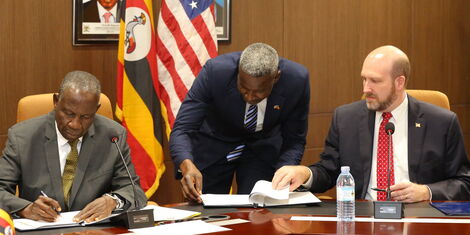
In a significant move for East African healthcare, the United States has signed a comprehensive five-year health cooperation agreement with Uganda, valued at approximately Ksh297 billion ($2.3 billion). The deal, inked on December 10, 2025, by U.S. Ambassador William W. Popp and Uganda’s Finance Minister Mattia Kasaija, signals a strategic pivot toward fostering self-reliance.
The agreement commits the U.S. to provide up to Ksh220 billion ($1.7 billion) in health funding. In return, Uganda pledges to boost its domestic health spending by over Ksh64 billion ($500 million). This co-investment model is being framed as a cornerstone of a renewed partnership.
Ambassador Popp emphasized the shift in philosophy at the signing ceremony, stating, “This agreement represents a significant commitment by the United States and Uganda to co-invest in our shared global health priorities.” The funds are earmarked for combating HIV/AIDS, tuberculosis, malaria, improving maternal and child health, polio eradication, and strengthening disease surveillance and emergency preparedness.
A key component of the pact involves Uganda gradually assuming responsibility for procuring medical commodities currently managed by the U.S., alongside investments in data systems and electronic medical records. The deal also explicitly supports faith-based healthcare providers and aims to transition health workers onto the Ugandan government payroll.

“This collaboration will yield not only disease-specific outcomes but also significant improvements in national systems, institutions, and workforce capacity,” Finance Minister Kasaija remarked, acknowledging the partnership’s broader developmental impact.
The Ugandan agreement comes just days after neighboring Kenya signed a similar Ksh207 billion ($1.6 billion) deal with the U.S. on December 4. However, Kenya’s pact has been mired in controversy. The High Court suspended its implementation on December 11 following a legal challenge by the Consumers Federation of Kenya (COFEK) over data privacy concerns.
U.S. Embassy Chargé d’Affaires in Kenya, Susan Burns, sought to clarify, asserting that only aggregated statistical data would be shared, not private patient information. The bilateral agreements have been described by U.S. Secretary of State Marco Rubio as part of the Trump Administration’s “America First Global Health Strategy,” aimed at reducing long-term dependency on American aid.
The contrast between the two rollouts is stark: Uganda celebrates a milestone for health sovereignty, while Kenya grapples with legal and privacy debates. With over 60 years of collaboration, the U.S. remains Uganda’s most significant global health partner, and this latest agreement seeks to redefine that relationship for a new era of shared investment and responsibility.